SDA Design Categories Explained: Improved Liveability to Robust
Not all Specialist Disability Accommodation (SDA) homes are built the same way, and that’s deliberate. A home designed for someone with sensory or cognitive support needs looks very different from one built for someone who needs a ceiling hoist or backup power for medical equipment. That difference comes down to SDA design categories, and understanding them properly is one of the most useful things a Perth NDIS participant or family can do before applying for SDA funding.
At Innovative Disability Services & Accommodation, a registered NDIS provider (Reg. No. 0405 016 4686) based in Cockburn Central, we help participants across Perth’s southern corridor understand exactly which design category fits their needs before they commit to a home. If you’d like to talk this through, call us on 0481 780 816 or email info@innovativedisability.com.au.
What Are SDA Design Categories, and Why Do They Matter?
SDA design categories are the four building classifications set out in the NDIS SDA Design Standard, the framework that governs how Specialist Disability Accommodation (SDA) homes must be designed and constructed. Every enrolled SDA dwelling is certified against one of these categories, and the category approved in your NDIS plan determines which properties you can actually move into.
This matters because the categories aren’t a ranking from basic to premium, they’re four genuinely different design responses to four genuinely different support needs. Getting the category wrong on paper, or misunderstanding what it actually means day to day, can mean months of delay finding a home that doesn’t truly fit.
It’s also worth remembering that SDA funds the home itself, not the people who support you in it. Support workers are funded separately, most often through Supported Independent Living (SIL) or an Independent Living Option (ILO), so the design category conversation is really about the building, not the care model.
What Is Improved Liveability SDA?
Improved Liveability is designed for people with sensory, intellectual, or cognitive impairment. Rather than focusing on physical mobility, this category prioritises how easily someone can understand, navigate, and feel safe in their environment.
In practice, that means design features like strong colour and light contrast between walls, floors, and doorways to aid wayfinding, layouts that let support workers see residents easily from common areas, and a level of physical access that still meets a reasonable accessibility benchmark. It suits participants who may not need a wheelchair-accessible home but do need an environment that reduces confusion and supports independence in daily routines.
What Is Fully Accessible SDA?
Fully Accessible SDA is built for people with significant physical impairment, most often participants who use a wheelchair some or all of the time. This category incorporates a high level of physical access throughout the entire home, not just in one or two rooms.
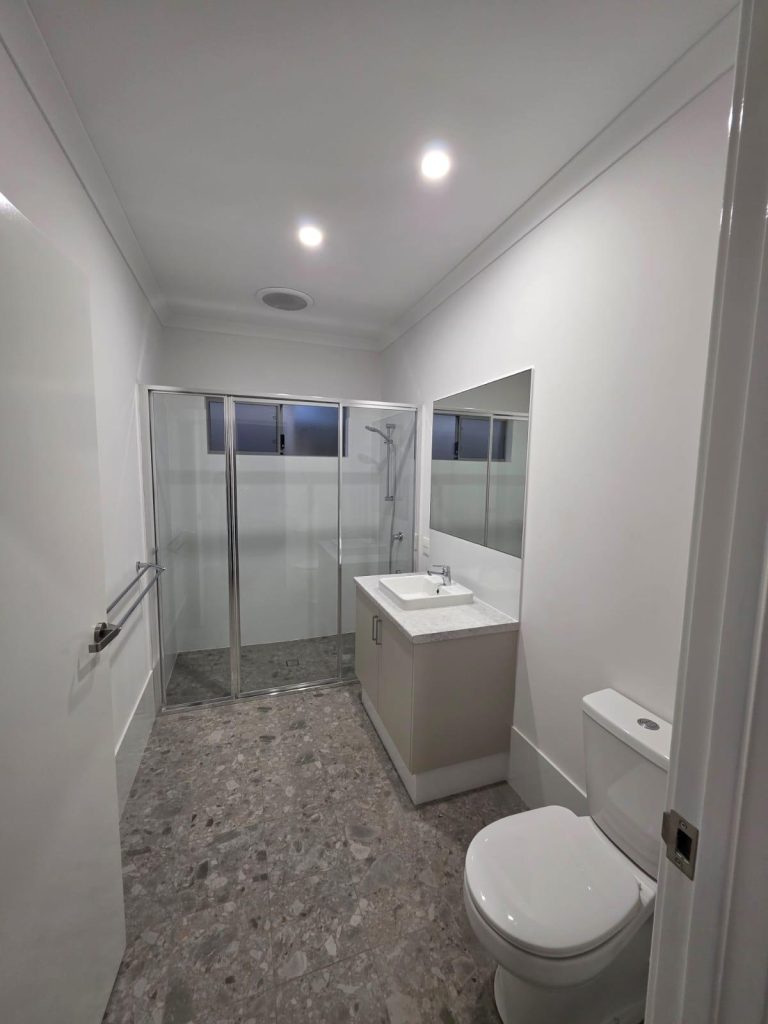
Typical features include step-free access to every external door and outdoor area, bathrooms with vanities and hand basins usable from a seated or standing position, and kitchens designed so benches, sinks, and appliances can be reached without needing to stand. Doorways and hallways are wider than a standard home, and there’s often provision for automated doors or window controls to be added later if needed.
What Is High Physical Support SDA?
High Physical Support builds on everything included in Fully Accessible, then adds significantly more for participants who need very high levels of physical support. This is the category most closely associated with complex medical and mobility needs. It’s often approved alongside Supported Independent Living (SIL) funding, since the support needs that justify this design category are usually intensive enough to require rostered, hands-on care as well.
Structurally, that means reinforced ceilings and provisions for ceiling hoists, wider clear-opening doors to every habitable room, assistive technology readiness, home automation for things like lighting and communication, and backup power solutions that can sustain essential equipment through an extended outage. These aren’t optional extras, they’re built into the home from the ground up.
What Is Robust SDA?
Robust SDA is often the most misunderstood category, because it’s not primarily about physical access at all. It’s designed for participants who may have complex behavioural support needs, including some people with autism or psychosocial disability, where the priority is a durable, low-maintenance environment that reduces risk to the resident, other people in the home, and the property itself.
Robust homes use impact-resistant wall linings, secure and durable doors and windows, laminated glass, and fittings designed to withstand heavy use without becoming a safety hazard when damaged. The goal isn’t to feel institutional, it’s to genuinely reduce the anxiety and disruption that comes from a home that can’t handle real behavioural needs, while still supporting everyday independence.
How Does the NDIA Decide Which Category You're Approved For?
Eligibility for a specific design category is based on functional impairment and support needs, not a diagnosis label. Two participants with the same condition can genuinely need different categories, which is why an independent assessment, usually involving an occupational therapist, plays such a central role in the process.
That assessment looks at how you actually manage daily tasks such as mobility, personal care, and communication, alongside safety considerations in your current living situation. The evidence gathered feeds into your NDIA planner’s decision about which category, and which SDA funding level, is included in your plan.
Common Mistakes When Choosing an SDA Design Category
The most common mistake is assuming a “higher” category is automatically a better outcome. These categories aren’t a quality scale, a Robust home isn’t superior to an Improved Liveability home, it’s simply built for an entirely different kind of need. Choosing based on category name rather than actual fit leads to homes that don’t work in practice.
The second common mistake is confusing SDA funding with support funding. SDA pays for the building. It doesn’t cover personal care, support workers, or day-to-day assistance, those come through SIL, ILO, or other parts of a participant’s plan. Families sometimes assume approval for one automatically means approval for the other, which isn’t the case.
A third mistake is skipping a proper assessment in favour of a vacancy that’s simply available. A home that technically meets a category’s design standard still needs to suit the individual living in it, location, housemates, and layout all matter well beyond the certified category.
If you’re weighing up SDA design categories for yourself or a family member, our Cockburn Central team is happy to talk it through in plain language. Call 0481 780 816 or email info@innovativedisability.com.au to get started.
Frequently Asked Questions
The right category depends on your functional impairment and support needs, not your diagnosis. An independent assessment, usually involving an occupational therapist, helps determine which category best matches your daily living and safety requirements.
Generally, your NDIS plan will specify one design category based on your assessed needs, though some dwellings are built to meet more than one category's requirements at once, such as combining Fully Accessible and High Physical Support features.
No. Each category is designed for a different need, not a different quality level. A Robust home isn't "better" than an Improved Liveability home, it's built for a completely different kind of support requirement.
No. SDA funding pays for the home itself. Support workers are funded separately, usually through Supported Independent Living (SIL) or an Independent Living Option (ILO), depending on your circumstances.
Call Innovative Disability on 0481 780 816 or email info@innovativedisability.com.au. Our Cockburn Central team can talk through your NDIS plan and help you understand which design category genuinely fits your needs.